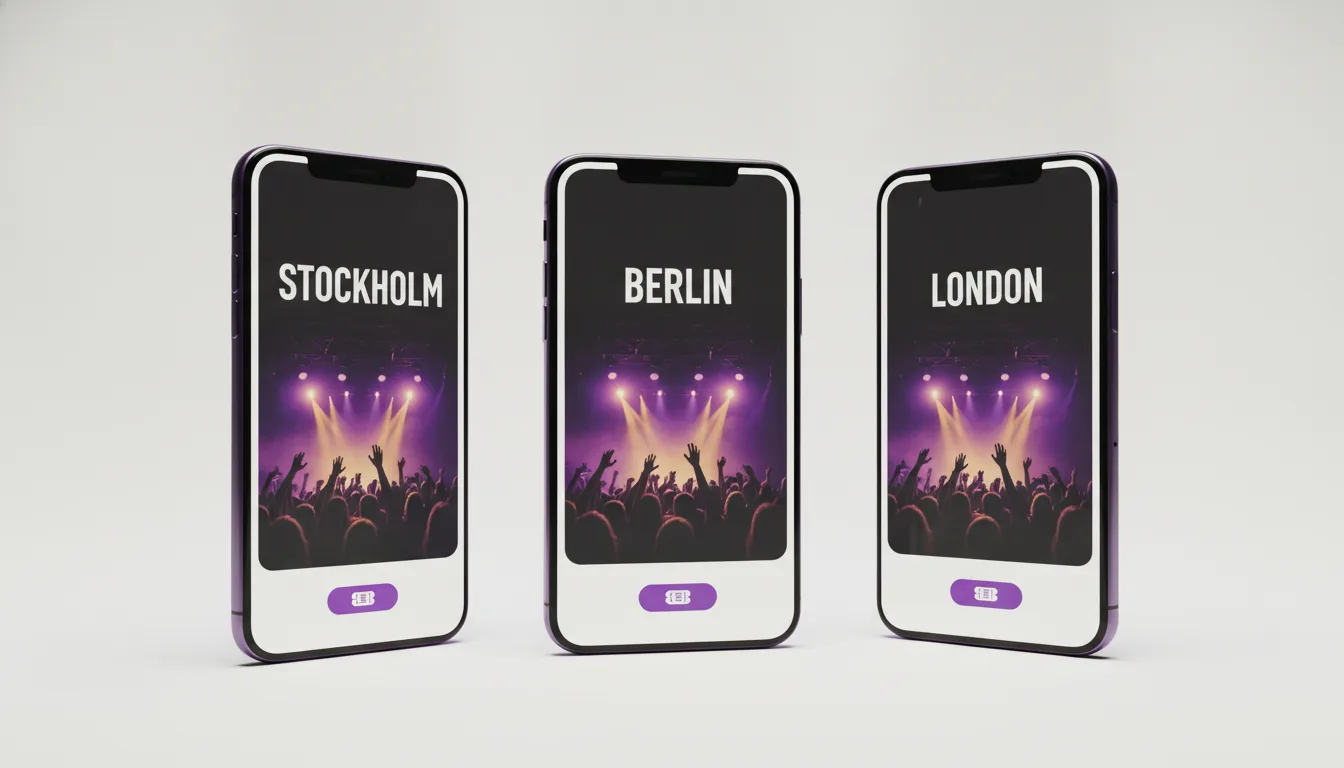
Theatre marketing for touring productions is the work of selling the same show to a new local audience in every town on the route, usually with a few weeks of paid advertising per venue rather than one long national campaign. The core rule is simple: each tour date is its own small campaign, with its own city targeting, its own budget, its own ticket link and its own on-sale timeline, all built from one shared set of trailer footage, production photos and artwork.
Key Takeaways
- Treat every venue on the tour as a separate campaign with its own audience, budget and ticket link, built from one shared creative kit.
- Facebook and Instagram do most of the selling for touring theatre, Google search catches people already looking for the show, and YouTube carries the trailer.
- You can only manage what you can measure, so the Meta Pixel and Conversions API on the ticket page come before the first euro or dollar of ad spend.
If you would rather have the film, images and ads handled as one job, Adsome makes and runs the advertising for touring productions.
What is theatre marketing for a touring production?
Theatre marketing for a touring production is everything that gets people in each tour town to buy a ticket: the poster and key art, the trailer, the venue listing, the press, and the paid ads that put all of it in front of the right local people. A touring production is a show that plays a run of venues in different towns, from a single night to a few weeks in each, instead of staying in one theatre.
Unlike a resident theatre, you never build up a local audience over time. Each town meets the show fresh. The venue usually markets through its brochure, email list and website, while the producer or promoter normally pays for the paid social and search ads. Agree in the contract who pays for what, or a date can end up with no advertising at all.
Why touring theatre sells differently from concerts
Concert ads sell an artist people know. Touring theatre often sells a production the town has never seen.
- The audience buys the experience. Unless the cast or title is famous, the ad has to show what the evening feels like.
- The buyer is often older and plans ahead. Theatre audiences in the 40+ age range still buy through Facebook, and they often buy for a group: a couple, friends, a family outing. Name the date, venue and town clearly.
- Gift buying matters. Christmas shows, family shows and musicals often sell as presents, so follow the gift season too.
- Reviews carry real weight. A real star rating or review line, used with permission, is strong material for a theatre ad.
The creative kit every touring show needs
The creative kit is the shared set of film, images and text that every venue's ads are built from. You make it once and then adapt it per town. A good kit has:
- A trailer in several lengths. Short cuts for Instagram Stories and Reels, a slightly longer one for Facebook feed and YouTube.
- Production photos that show faces and action, not just a wide shot of a stage.
- Key art (the poster image) without text baked in, so you can add the town, date and venue for each stop.
- Short audience reaction or rehearsal clips if you have them.
- Approved review quotes with the outlet's name, ready to drop onto images.
Make the vertical version from the start. People see these ads on phones, and a trailer cut only for a cinema screen looks small there. Our guide on what to film at a show so the video sells the next one is written for concerts, but the same shot list works for a stage production.
How to run the ads venue by venue
This is the order we would plan a touring theatre campaign in. It is a planning sequence, not a button by button setup.
- Check the ticket page tracking. Make sure the Meta Pixel (a small piece of code from Meta that records what people do on your ticket page) and the Conversions API (a server connection that sends the same purchase events to Meta even when a browser blocks the pixel) are both live on the ticketing page for every venue. Ask the ticketing company; most of the big ones support it.
- Build one campaign per venue. Name it with town, venue and date. Use a location radius around the venue that matches how far people actually travel to that theatre, which is wider for a regional town than a capital city.
- Set the on-sale burst. The first days after a venue goes on sale are when your most interested fans buy. Put a clear share of each venue's budget there.
- Run a steady middle phase. Keep the trailer and the strongest photo ads running at a lower level, and add review quotes as soon as the tour has opened and the reviews come in.
- Add retargeting. Retargeting means showing ads again to people who visited the ticket page or watched most of the trailer but did not buy. They are usually among the cheapest tickets you sell.
- Run a final push. Many theatregoers book late, so raise the budget again in the last weeks before each date, with ads that say how soon the show is.
- Read the results per venue every week. Move money from dates that are close to full towards dates that are behind.
Our article on advertising a multi-city tour on Facebook city by city goes further into the city structure.
Exactly how to split the budget between phases, which audiences to combine and when to switch creative is the part that takes experience to get right. It changes with genre, venue size and how far ahead a town buys, and it is most of what a specialist team does on a tour.
Which channel does what for a touring show
Each channel has a different job. The table compares them on the things that decide where your money goes.
| Channel | Who it reaches | Best job on a theatre tour | What you need | How you see sales |
|---|---|---|---|---|
| Wide adult reach, strong in the 40+ age range | Selling tickets town by town, group and gift buyers | Trailer, photos, key art per venue | Pixel and Conversions API purchase events in Ads Manager | |
| Younger adults, strong on Reels and Stories | Awareness for musicals and family shows, younger theatregoers | Vertical trailer cuts, short clips | Same as Facebook, same Ads Manager | |
| Google Search | People already typing the show name, "tickets" or the venue | Catching people who already want to go | Text ads with town and date | Conversion tracking on the ticket page |
| YouTube | Broad video audience, can be targeted by location | Showing the full trailer before on-sale | A trailer of 30 seconds or longer | View and conversion reports in Google Ads |
Facebook and Instagram run from the same Ads Manager, so tours usually treat them as one budget. Google Search reaches fewer people, but they are already looking. For a fuller comparison, see Facebook ads vs Google ads for selling tickets.
How much to spend per tour date
There is no single right figure. Work backwards from what you can afford to pay per ticket.
Here is the arithmetic with example figures, not real campaign data. Say a venue has 800 seats, the average ticket is EUR 45 (about USD 50), and you need to sell 300 of those seats through paid ads because the venue's own list and walk-up sales will cover the rest. If you decide you can spend 10 percent of the ticket price on advertising, that is EUR 4.50 per ticket, and 300 tickets gives a ceiling of EUR 1,350 (about USD 1,500) for that date. Your own numbers will differ, but the method stays the same: capacity, expected paid share, ticket price, the share you can spend.
Then compare your real cost per ticket in Ads Manager with that ceiling. Our guide to return on ad spend for a tour walks through how to read that number without fooling yourself.
Which fits your situation
- A small producer with one show and a short regional tour. Keep it simple. One trailer, a handful of photo ads, one campaign per venue on Facebook and Instagram, and Google search ads on the show name.
- A producer with a long tour and a known title. Search and retargeting will do a lot of the work, so put effort into the final push in each town.
- A new or unknown production. Invest in a strong trailer and reaction clips, and give each venue a longer run of ads.
- A family or Christmas show. Plan around the gift season and around school holidays, and make the price and the age suitability clear in the ad.
What we see in our own accounts
Adsome is a Stockholm-based agency that makes the film and images and runs the Facebook, Instagram and Google ads for touring productions, for artists and acts such as Galenskaparna, Smokie and Christer Sjögren. What follows is our own observation from that work, not a published study, given in words because results differ too much between shows for an average to mean much.
What we see most often on touring stage shows is that the ads made from real footage of the production beat ads made from the poster alone, because the audience wants to see what the evening looks like before they book it. We also see that budget can only be moved sensibly in the final weeks when tracking works on every venue's ticket page. Where it was missing, decisions for that date were guesses.
Common Mistakes
- One national campaign for the whole tour. Meta spends where results are cheapest, not where tickets are needed, so some towns get almost nothing.
- No tracking on the ticket page. Without the pixel and Conversions API you cannot tell which ads sold tickets, so you cannot move budget with any confidence.
- Hiding the date and town. Put when and where on the image and in the first line of text.
- Stopping the ads once a date looks healthy. Late bookers still need reminding, and pulling budget early leaves seats empty.
- Using the cinema cut of the trailer everywhere. Use square and vertical cuts with captions, because many people watch with the sound off.
- Waiting for the venue to do it. Check what the venue will do and plan your ads to fill the gap.
Want your next tour to sell out? Adsome makes the film and images and runs the Facebook, Instagram and Google ads for touring productions.